High-tech solar manufacturing in the Kingdom.
Insola KSA is developing a 1 GW n-type IBC bifacial solar PV cell-and-module plant at King Salman Energy Park in Dhahran, built on proven German cell technology already in commercial production at scale, by the same engineering partners, in China and Lithuania.
The opportunity - Why Saudi Arabia
Saudi Arabia has the irradiance, an industrial city built for the energy value chain, and the largest module demand in the region. Very few places have all three.
Solar resource
Saudi Arabia records solar irradiance above 2,000 kWh/m² a year. The Kingdom’s Al Henakiyah project reached $10.4/MWh, reported as the lowest solar tariff recorded anywhere. The modules are made in the market that installs them.
Location and logistics
King Salman Energy Park sits 30 km from Dhahran, 60 km from King Fahad International Airport and 70 km from King Abdulaziz Seaport, with an on-site dry port to be served by the GCC Railroad. A single utility provider covers power, water, telecom and waste across the park.
Aligned with Vision 2030
Vision 2030 targets 58.7 GW of renewable capacity by 2030, from roughly 2.7 GW installed, implying about 5.5 GW of installations a year. Saudi Arabia imported 16.55 GW of modules from China in 2024, the largest such market in the region. Local manufacturing is the gap.
Established cell technology
The plant is built on an established German n-type IBC cell technology, transferred to commercial production lines in China and Lithuania by the same engineering partners and in mass production since 2020.
- Annual production capacity
- 1 GW
- Plot at SPARK, Dhahran
- 9.3 ha
- polyZEBRA design cell efficiency
- 25.5%
- Saudi renewables target by 2030
- 58.7 GW
Solar-resource, module-import and renewable-target figures per published third-party market sources; SPARK site and logistics figures per King Salman Energy Park. Forward-looking project details on this site are indicative.
Where we are - From origination to production
Every Insola project moves through the same five stages, from first look to full production. In the Kingdom, the site is secured at SPARK and the company is being established: investment registration is issued and incorporation is at an advanced stage. Land, licence, financing and construction are the work ahead.
- Complete
Stage 1
Origination & site selection
- The Kingdom chosen as the site for the group’s Middle East plant
- Land application lodged with and approved by SPARK in October 2025
- A plot of approximately 9.3 hectares allocated and zoned for the project at SPARK, Dhahran
- We’re here
Stage 2
Establishment in the Kingdom
- Investment registration issued by the Ministry of Investment in September 2026
- The name Insola KSA authorised, and incorporation at an advanced stage
- A 50/50 joint venture between Strand Hanson and Solunex, with the board and banking being put in place
- Ahead
Stage 3
Land, licence & design
- Concluding the long-term Musataha lease for the SPARK plot
- Sub-licensing the polyZEBRA technology from EquuSol with ISC Konstanz’s consent
- Detailed design and the SPARK permitting pathway, including environmental approval
- Ahead
Stage 4
Financing & construction
- Assembling the project capital stack toward financial close
- Building the plant and its dedicated 115/13.8 kV substation
- Equipment installation and commissioning
- Ahead
Stage 5
Production
- n-type IBC cells and modules coming off a Saudi line
The technology - Proven German n-type IBC cells
The cell technology is polyZEBRA, developed by ISC Konstanz in Germany and running in commercial-scale plants in China and Lithuania, built by the same engineering partners the Saudi plant will use.
High conversion efficiency
n-type IBC cells reaching around 25% conversion, with champion cells at 25.7%, and module efficiency up to 24.6%.
Bifacial energy gain
All contacts sit on the rear face, so there is no front-side shading and the module generates from both sides. On high-albedo desert ground the rear-side gain over a monofacial module exceeds 20%.
Built for hot, bright climates
n-type silicon resists PID, LID and LeTID degradation, with a low temperature coefficient of −0.26%/K, well suited to a high-irradiation site.
All-black module face
With no busbars on the front, the module reads as a single black plane. It suits roofs and facades where appearance matters.
The plant design is already running at 2.2 GW in Turkey.
The Saudi facility follows the design principles of the 2.2 GW Kalyon plant in Turkey, delivered by RCT Solutions, with the newer n-type polyZEBRA back-contact cell in place of p-type PERC. The cell technology has been transferred into industrial production twice before, the equipment set is defined, and the supplier base is established. Saudi Arabia imports the modules this plant makes.
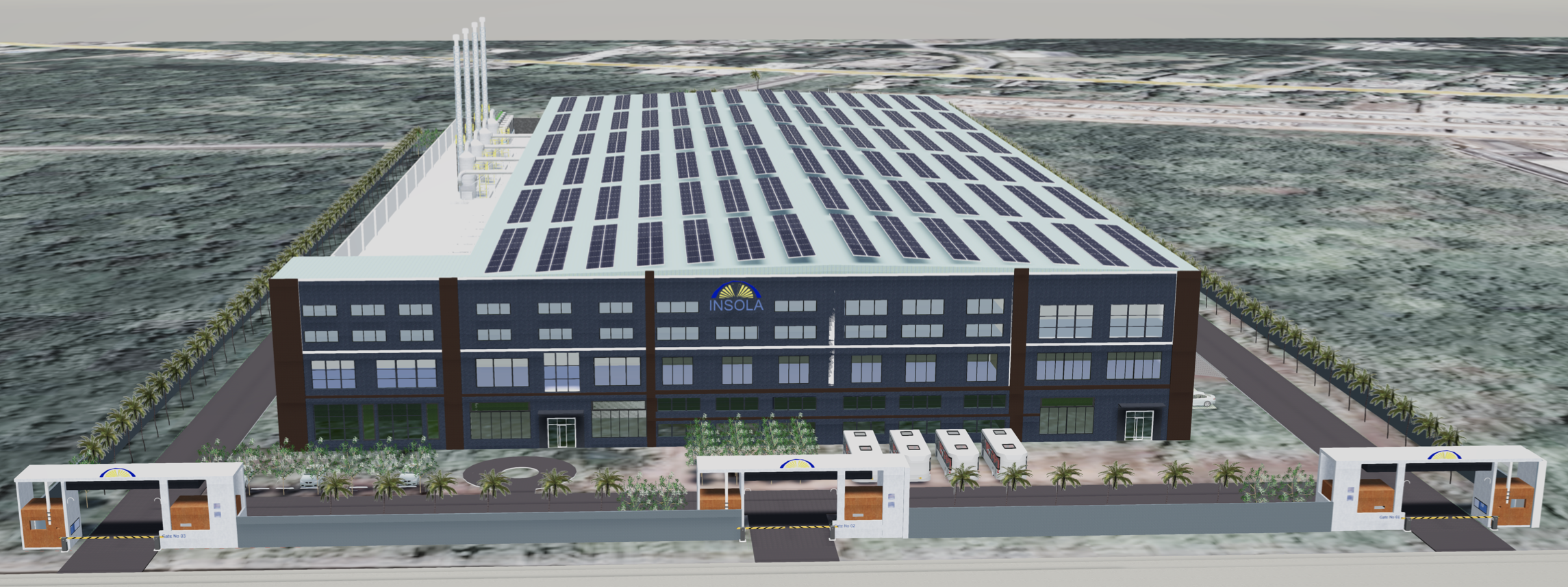
The plant at SPARK
A 1 GW integrated cell-and-module facility on approximately 9.3 hectares at King Salman Energy Park, designed to modern Industry 4.0 standards, with on-site solar generation and water recycling built into the design.
Explore the conceptIn partnership with
Strand Hanson
Joint venture partner, a London corporate finance adviser authorised and regulated by the Financial Conduct Authority, leading the registration of the project company in the Kingdom and the project financing. Insola KSA is a 50/50 joint venture between Strand Hanson and Solunex, prior to dilution on future funding rounds.
EquuSol
Licensing partner, the group’s technology and intellectual-property holding company and owner of the Insola brand. The Saudi sub-licence for the polyZEBRA cell technology is granted by EquuSol with the consent of the German technology owner.
ISC Konstanz
The German non-profit solar research institute that developed the ZEBRA and polyZEBRA n-type back-contact cell technology and is the technology partner to the group, a relationship running since 2020.
King Salman Energy Park (SPARK)
Host industrial city, a wholly owned subsidiary of Saudi Aramco, developed to localise the energy value chain and targeting more than 50% of the park’s own energy demand from renewables by 2030.